
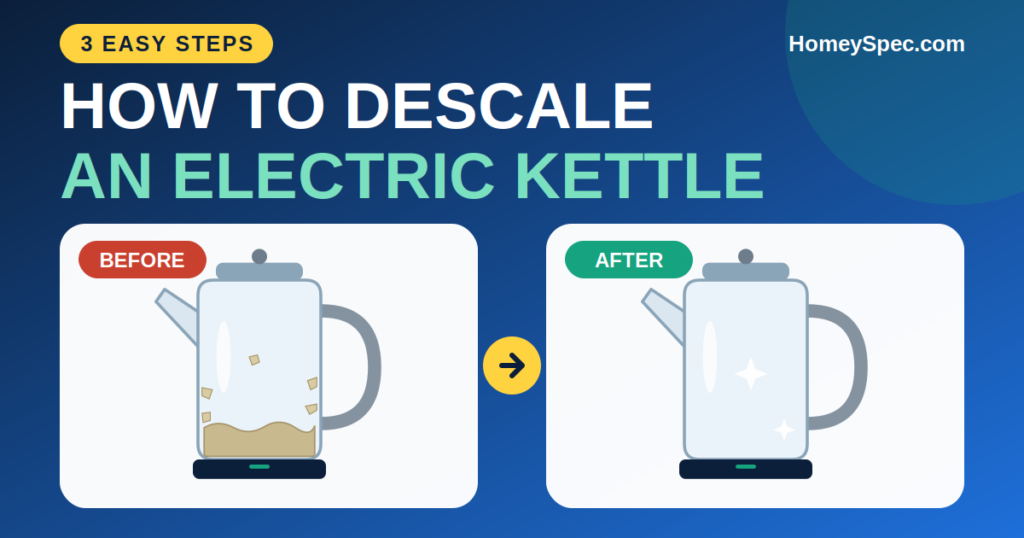
If your kettle takes longer to boil, makes a loud rumbling sound, or has white flakes in your tea, then it is almost certainly due to limescale. It will take about half an hour to learn how to descale an electric kettle, the cost is very low, and as a result you’ll have quicker boiling and water that tastes cleaner. The following guide includes information on the problem, the reason for it, the three simple steps, some safety advice, and answers to common questions.
Whenever the white scale builds up again, if you know how to descale an electric kettle then you can carry out the procedure and this will prevent unnecessary strain on the heating element.
Table of Contents

The Problem: Why Your Electric Kettle Gets Dirty
I’ve noticed a chalky buildup inside kettles, especially in areas with hard water. It begins as a thin layer deposited on the base and walls, continuing to share the heating element. Ultimately, more tiny bits of buildup will become separated from the surface and enter into contact with water. At the beginning stage, buildup can conveniently be ignored but, when it is not prevented, it will inevitably get denser through time.
Indications of descaling your kettle:
- Light-colored crust on the walls of the kettle
- Light particles seen on top of tea or coffee made with the kettle
- Longer boil times than usual for the kettle
- Loud rumbling or crackling while the kettle is heating
- A chalky or metallic taste in drinks from the kettle
- Scale trapped in the spout filter of the kettle
The minerals, behind limescale are not considered a health hazard since the USGS explains that calcium and magnesium are not toxic. So a scaled kettle works harder tastes worse and looks unpleasant.
The Causes of Limescale Buildup in Electric Kettles
The limescale is derived from the minerals found in your tap water. As water is boiled, the dissolved minerals calcium and magnesium precipitate into scale and accumulate on the kettle. Below are factors that contribute to this issue:
| Factor | Why it contributes to limescale formation |
|---|---|
| Treated water being hard | Hardness of water caused by greater amounts of dissolved calcium and magnesium present in it. |
| Water being kept inside kettle | Water keeps sitting in the kettle for a while until some of it gets evaporated leaving minerals. |
| Water being boiled in the same kettle | Using batches of water repeatedly for boiling increases the concentration of fallout in the kettle. |
| Using that kettle regularly | More water boiling cycles are used, leading to higher buildup of sedimentation. |
| Failure to clean kettle regularly | Thin layers of limescale make it very hard to remove. |
How to Descale an Electric Kettle: What You Will Need
- White distilled vinegar or food-grade citric acid powder
- Clean water
- A soft sponge or an old toothbrush
- A microfiber cloth
- Dish soap (optional)
- A measuring cup or spoon
Guidelines for Maintaining the Safety While Descaling Electric Kettle
- In the first place, read the manual. There is some variety of kettles that require cleaning via descaling, either through vinegar or citric acid, while other varieties require different cleaning materials.
- Moreover, avoid mixing vinegar with any other cleaning materials such as bleach, for it can cause the production of hazardous gases. Moreover, one should avoid filling the kettle over certain limits for it can create a mess.
- Make use of a soft sponge for cleaning purposes. Do not use any hard scrapers. If vinegar is used to remove scale from the kettle, it should be used in a well-ventilated area.
- Place that cleaning substance where pets and children cannot reach it.
How to Descale an Electric Kettle in 3 Easy Steps

Step 1: Pour the descaling mixture into the kettle
Unplug your kettle and wait for it to cool down. Mix equal proportions of white vinegar and water in the kettle, filling it about halfway to the MAX line but covering the scale line.
For citric acid, you would need to dissolve 2 tablespoons of it (25 to 30 g) per 500 ml of water. That is the amount recommended by brands like Breville.
Step 2: Bring the mixture to boil and leave it to soak
Put the kettle on fire, now boil your mixture. Wait for twenty to thirty minutes, or an hour If your water has left behind a really stubborn layer of crusty white scale. You’ll definitely notice how the scale begins to dissolving.Wipe away the remaining scale at the bottom of the kettle and the spout with a sponge or old toothbrush.
Step 3: Wash and repeat with clean water
Get rid of your mixture and rinse kettle thoroughly with running water.Pour fresh water, boil and empty the kettle. Repeat again in order to eliminate any smell of vinegar. Then wipe the exterior with a microfiber cloth.
How to prolong the lifespan of kettle so that it does not accumulate limescale
Assuring the lifetime of your kettle doesn’t happen just by turning off the spout. Each time you boil it, the mineral will stick to the kettle little by little, and one morning you will notice a kind of white dandruff in the tea. It’s hard, but in most cases it can be prevented.
Let’s start with the rest of the water. Do not leave it as it is. Pour hot water into the cup, immediately throw away the rest. The water that is left unattended is the cause of leaving minerals on the inner walls of the heater and kettle.
The same applies when pouring hot water. If you only need one mug, boil one. Try to use fresh water every time. This will save you a little bit of electricity, which is great.
In many homes, hard water is the real cause. Using a filter jug or soft water will be the most beneficial for your home. To put it bluntly, if you could change just one thing, change that one thing.
A quick wash of your inner skin on a weekly basis is enough if you wipe it down after. It takes less than a minute, and it is shorter.
Don’t ignore the spout filter either. That small mesh catches pieces of limescale, so it clogs faster than you think. Sometimes, wash under warm running water.
Descaling an Electric Kettle: Frequently Asked Questions
What alternative method to vinegar can be used for descaling an electric kettle?
Try citric acid instead. Just add it to water in the kettle and boil it. Keep the solution for 20-30 minutes and afterwards, throw it out, rinse, and boil plain water two times. It’s beneficial since citric acid has a much less strong smell than vinegar.
How often should I descale my electric kettle?
Cleaning your kettle once a month or once every few months would be sufficient in most cases. If at all, cleaning it once a month would be required if you live in an area with hard water and using the kettle often.
Is it safe to use vinegar in the kettle?
Normally, yes, as long as it is diluted and you have a kettle that is made of glass or stainless steel. However, it’s best to check the manufacturer’s instructions first. After cleaning your kettle with vinegar, make sure to boil water twice in it to get rid of the smell of vinegar.
Is there any substitution for vinegar such as citric acid?
Yes. People often choose citric acid over vinegar because it’s odorless. To use it you should dilute 2 tablespoons of citric acid in 500 ml of water and apply the same rinsing technique as before.
Can I use lemon juice to wash out a kettle?
Yes, lemon juice can help with minor limescale build-up, as lemon juice has citric acid in it, as explained by kettle cleaning guidelines. However, in the case of significant build-up, the situation is different and vinegar or citric acid powder without the pulp should be used.
Is it ok to drink out of a kettle with limescale in it?
Not really, considering that the majority of the chemically formed limescale is just calcium and magnesium, as pointed out by the United States Geological Survey. However, due to the presence of limescale, tea may taste bad so it’s better to get rid of it.
Why limescale came back into the kettle after cleaning?
In certain cases, it may be required to repeat the procedure several times or soak more thoroughly. Repeat the instructions, scrape the remained flakes off by a sponge and rinse.
FINAL THOUGHTS
If you would like to learn how to descale your electric kettle, it only takes three simple steps and some common supplies. This would save you the trouble of boiling and getting unwanted residues in your drinks and not having to buy a new kettle anytime soon. The kettle should be filled with water and boiled, soaked and rinsed, and finally kept empty and dry while not in use.